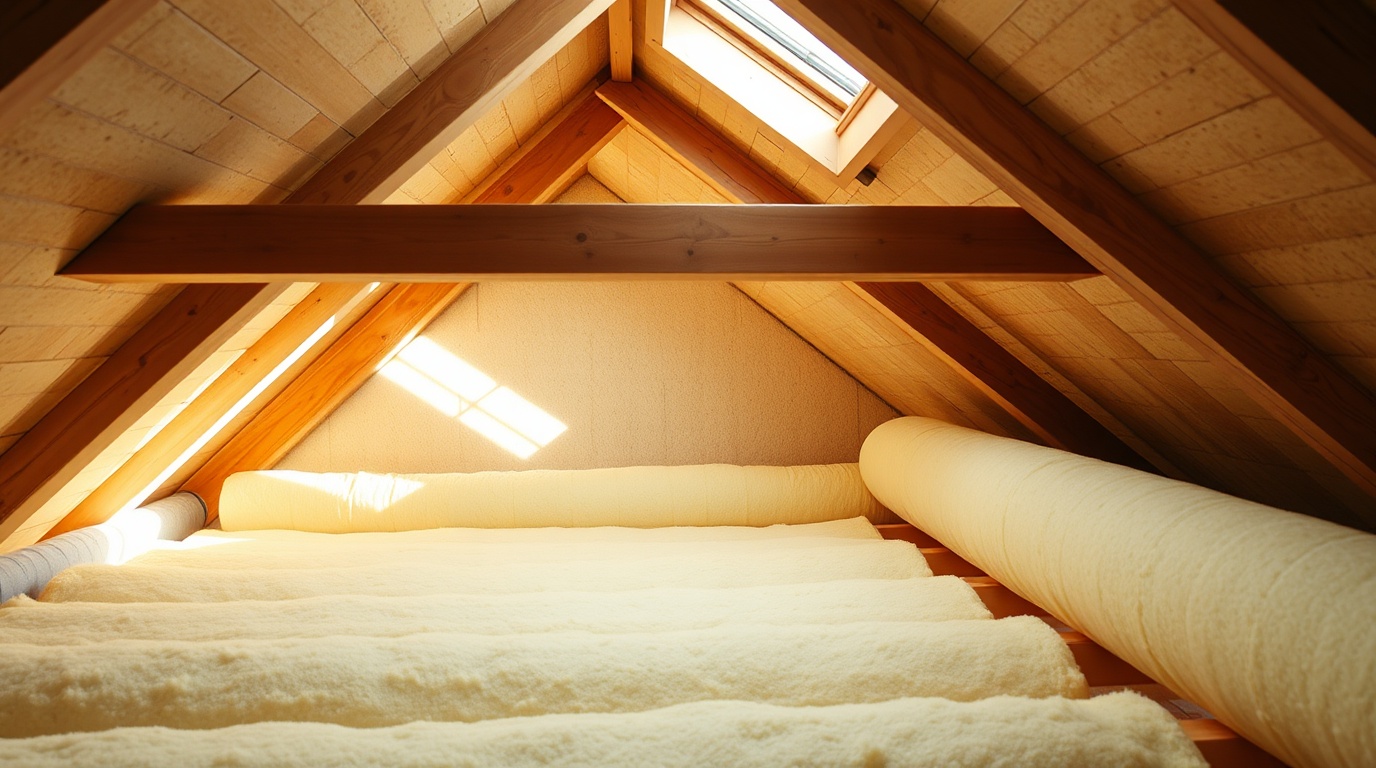
The short answer
A loft with a room in it is a warm-roof job, not a simple ceiling top-up. Because the space is heated and lived in, the insulation has to follow the shape of the room: the sloping ceilings are insulated at rafter level (usually with rigid PIR boards between and under the rafters), the small vertical dwarf walls behind the eaves are insulated, the flat ceiling at the top is insulated like a normal loft, and the little triangular void behind the dwarf walls is dealt with too. The aim is a continuous insulated envelope around the room reaching a U-value near 0.16–0.18 W/m²K, with a vapour control layer on the warm side and ventilation maintained above the insulation. A proper room-in-roof conversion is building work that must meet the relevant Building Regulations, so it's normally a designed job rather than a DIY top-up.
Insulating an existing loft room is more involved than rolling wool over a cold ceiling, because you have to wrap insulation around an irregular, heated space. Here's how the parts fit together.
Room-in-roof insulation
- Sloping ceilingsrigid board at rafter level
- Dwarf (knee) wallsinsulated behind the plasterboard
- Flat top ceilinginsulated like a cold loft
- Target U-value~0.16–0.18 W/m²K
- NeedsVCL + ventilation + Building Regs
The parts of a loft room you have to insulate
A converted loft is rarely a simple box. To stop heat escaping you have to insulate every surface between the heated room and the cold outside:
- Sloping ceilings (the rafters): the main heat-loss area. Insulated at rafter level, typically with rigid PIR/PUR boards fitted between the rafters and a further layer under them, keeping a ventilation gap above where required.
- Dwarf walls (knee walls): the short vertical walls where the slope meets the floor. These need insulating, because the triangular space behind them is cold.
- The void behind the dwarf walls: either insulate the dwarf wall and ventilate the void, or insulate the sloping rafter all the way down — the detailing matters to avoid a cold bridge.
- The flat ceiling at the top: the small horizontal ceiling above the room, insulated much like a normal cold loft.
- Any gable walls: insulated as walls where they enclose the room.
The goal is a continuous envelope with no gaps where the insulation stops short, since cold bridges at junctions are where condensation and heat loss concentrate.
The reason this matters so much more than in a cold loft is that the room is heated, so every uninsulated surface is a live heat-loss path being driven by the warmth you are paying for, not a cold buffer zone that simply sits there. Miss the dwarf walls and the room is warm at head height but cold at the skirting; skimp on the flat top ceiling and heat pours straight up; leave a gap where the slope meets the dwarf wall and you create both a draught and a cold spot where condensation can form. Wrapping the whole space without breaks is therefore not a counsel of perfection but the basic requirement for the room to feel warm and stay dry — which is precisely why it is a designed job rather than a matter of unrolling wool.
Why rigid board, not mineral wool rolls
At rafter level there is far less depth available than above an open ceiling, so the insulation has to be high-performance per millimetre. That's why rigid PIR or PUR boards are the usual choice for the slopes — they reach the required U-value in less thickness than mineral wool, preserving headroom in the room. Where a ventilated cold-roof detail is used, a gap is left above the insulation between it and the roof underlay so air can still flow; an unventilated warm-roof detail instead relies on a continuous vapour control layer and the correct membrane build-up.
| Surface | Typical insulation | Why |
|---|---|---|
| Sloping ceiling | rigid PIR board at rafters | best performance per mm, saves headroom |
| Dwarf / knee wall | rigid board or batt | stops loss into cold side void |
| Flat top ceiling | mineral wool, like a cold loft | open space allows full depth |
| Behind dwarf wall (void) | insulate + ventilate as designed | avoids cold bridge and trapped damp |
Indicative approach for guidance; the correct detail depends on the roof and must follow current Building Regulations. Source: Energy Saving Trust, Approved Document L.
Building Regulations, vapour control and getting it right
Creating or upgrading a habitable loft room is building work, so it must meet the relevant Building Regulations — including the insulation standard (Approved Document L), structural and fire-safety requirements, and moisture control (Approved Document C). A vapour control layer on the warm side of the slope insulation is part of the correct build-up, limiting how much moist room air reaches the cold outer roof where it could condense. Ventilation has to be maintained too, either as an air gap above the insulation or through a designed warm-roof membrane system.
Because the detailing decides whether the room stays warm and dry or quietly rots, insulating a room-in-roof is best treated as a designed job rather than a weekend task. If you're upgrading an existing conversion that feels cold, the honest first step is to find out how it was built — where the insulation currently stops, whether the dwarf-wall voids are cold, and whether there's a vapour control layer — before adding more. Filling gaps at the junctions often does more than simply piling on extra board.
It is worth being clear about the difference between a cold-roof and a warm-roof detail at rafter level, because the two demand opposite things and mixing them is a common cause of hidden damp. In a cold-roof slope the insulation sits between and under the rafters but a continuous ventilation gap (typically at least 50mm) is kept above it, open to the eaves and ridge, so any moisture that reaches the cold outer zone is carried away by moving air — the same principle as a cold loft, just following the pitch. In a warm-roof slope there is no ventilation gap above the insulation; instead the whole roof build-up is kept dry by a tightly sealed vapour control layer on the room side and a breathable membrane on the outside, so the construction is designed to let any trapped vapour diffuse outward rather than be ventilated away. The danger is the in-between case: insulation pushed tight to a non-breathable felt with no ventilation gap and no proper vapour control, which traps moisture against cold timber and rots it from the inside. This is precisely why a competent designer, not a roll of wool and good intentions, should decide which system the roof is being built as — and why retrofitting board into an old conversion without knowing what membrane sits above it is a real risk rather than a safe top-up.
Two ways to detail the dwarf-wall void
The trickiest part of a room-in-roof is almost always the triangular void behind the dwarf walls — the cold space where the sloping rafter continues down past the knee wall to the eaves. There are two legitimate ways to handle it, and choosing the wrong combination is what leaves a converted loft cold and prone to damp:
- Insulate the dwarf wall, ventilate the void: the knee wall is insulated like a small wall, and the triangular space behind it is treated as a cold, ventilated zone connected to the eaves airflow. The room stops at the dwarf wall, and the void stays cold but dry. This is simple and robust provided the dwarf wall is insulated continuously down to the floor, with no gap where it meets the joists.
- Insulate the slope all the way down: the rafter insulation continues down past the knee wall to the eaves, bringing the void inside the warm envelope. This uses the void as storage but demands careful detailing so the insulation stays continuous and any ventilation gap above it is preserved right down to the eaves.
What you must not do is leave the dwarf wall uninsulated while also failing to insulate the slope behind it — that turns the back of the knee wall into a large cold surface and a direct path for heat to escape and for warm air to reach cold timber. A common real-world fault is insulation that stops at the top of the dwarf wall with a cold, unsealed gap at floor level behind it, which lets cold air wash under the room floor. Whichever approach is chosen, the principle is continuity: the insulated line must run unbroken from the flat top ceiling, down the slopes, and either across the dwarf wall or down to the eaves — never stopping halfway with a cold bridge at the junction.
Frequently asked questions
Can you insulate a loft that already has a room in it?
Yes, but it's a warm-roof job, not a ceiling top-up. You insulate the sloping ceilings at rafter level with rigid board, the dwarf walls, the flat top ceiling and any gable walls, aiming for a continuous envelope with a vapour control layer and maintained ventilation. It's designed work that must meet Building Regulations.
Why can't I just put mineral wool over a loft room?
Because the room is heated, the insulation has to wrap the sloping ceilings and walls at rafter level, not sit above the flat ceiling only. Rigid boards are used on the slopes because they reach the U-value target in less depth, preserving headroom that thick wool would lose.
Does insulating a loft room need Building Regulations approval?
A habitable loft conversion is building work and must meet the relevant Building Regulations, covering insulation (Part L), structure, fire safety and moisture (Part C). Insulation, ventilation and vapour control are designed together as part of that approval rather than added afterwards.
Sources & further reading
- Energy Saving Trust — roof and loft insulation
- gov.uk — Approved Document L (conservation of fuel and power)
Figures on this page are typical UK ranges drawn from published sources and depend on your specific loft. They are guidance, not a quotation.