The short answer
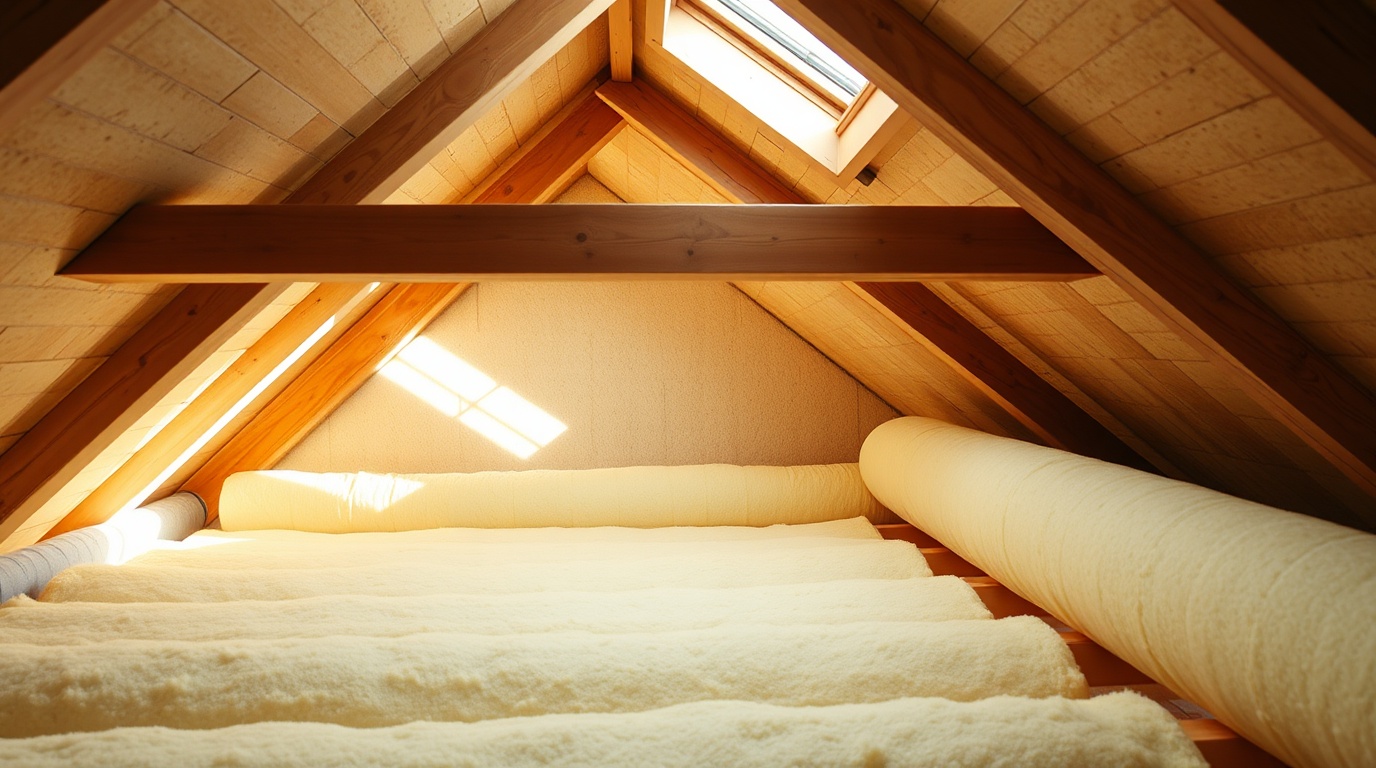
In a standard cold loft, insulation goes both between and over the joists. The usual method is two layers: a first layer of about 100mm laid between the ceiling joists, then a thicker second layer laid across (over) the joists at right angles to reach the recommended 270mm. The reason the second layer goes over the top is the cold bridge: the timber joists conduct heat more readily than the insulation around them, so if you only filled between the joists and left the timber exposed, heat would escape through the wood and the loft would underperform. Cross-laying a continuous layer over the joists covers that timber and lets the whole ceiling reach its target U-value of around 0.16 W/m²K. The trade-off is that you can no longer board directly onto the joists for storage — the insulation now sits above them.
This is one of the most common loft questions, and the answer is "both" — but the over-the-joists layer is the part that does the heavy lifting. Here's why.
Layering over joists
- First layer~100mm between the joists
- Second layeracross (over) the joists
- Why over the topcovers the timber cold bridge
- Total target~270mm to ~0.16 W/m²K
- Knock-oncan't board straight onto joists
What a cold bridge is, and why it matters
The ceiling joists in a typical loft are roughly 100mm deep. If you simply fill the gaps between them with 100mm of insulation, the wool sits flush with the top of the timber — and the timber itself is left exposed to the cold loft above. Wood conducts heat far better than insulation, so every joist becomes a cold bridge: a continuous line where heat leaks straight through the structure, bypassing the insulation either side. On a typical loft the joists make up a meaningful fraction of the ceiling area, so leaving them exposed noticeably worsens the overall U-value.
Laying a second, continuous layer of insulation across the top of the joists covers that timber, breaking the cold bridge. Now heat has to pass through unbroken insulation everywhere, and the ceiling can reach the target performance. This is the whole reason the recommended build-up is laid in two directions rather than just stuffing the gaps.
The standard two-layer method
The conventional approach for a cold loft is straightforward:
- First layer: roughly 100mm of mineral wool laid between the joists, filling the gaps to the top of the timber.
- Second layer: a thicker layer (around 170mm) laid over the joists at right angles to the first, so it forms a continuous unbroken blanket above the whole ceiling.
- Total: approximately 270mm, reaching a U-value of about 0.16 W/m²K.
Cross-laying the second layer at 90 degrees to the first also helps close any small gaps along the joist lines, giving more even coverage.
A small but important detail in this method is to lay the wool snugly but not squashed. The first layer should sit lightly between the joists, filling the bay without being stuffed in or stretched thin, and the second should be unrolled gently across the top so it lofts to its full thickness. Insulation traps heat in the still air held within its fibres, so packing it down or pulling it tight to make it reach further reduces the very thing that makes it work. Butt the ends of adjacent rolls together rather than leaving a sliver of gap, and the cross-laid top layer will cover any joins in the layer beneath — another reason the two-direction method gives a more even, gap-free blanket than a single layer ever could.
| Layer | Position | Approx depth |
|---|---|---|
| First | between the joists | ~100mm |
| Second | across / over the joists | ~170mm |
| Combined | covers timber + gaps | ~270mm |
Typical two-layer cold-loft build-up for guidance. Source: Energy Saving Trust roof and loft insulation guidance.
How deep are the joists, and why it matters
The reason a single layer between the joists rarely reaches the standard comes down to joist depth. Older houses commonly have ceiling joists only around 100mm deep, sometimes less. Fill those gaps and you have roughly 100mm of insulation — well short of the 270mm needed to reach a U-value of about 0.16 W/m²K. The remaining depth has to go somewhere, and the only sensible place is a continuous layer laid across the top of the joists.
Some newer homes have deeper joists, and occasionally the gaps alone hold more insulation, but the principle is unchanged: the timber must be covered for the loft to perform, because the exposed top of a joist is a direct heat path no matter how deep the gap beside it is. This is also why simply choosing a thicker first roll that sits proud of shallow joists is not the same as cross-laying — a proud roll still leaves the joist line exposed in places and is easily disturbed. A proper second layer at right angles gives an even, unbroken blanket. If you are checking your own loft, measure the total depth and look at whether the joists are visible above the insulation: if you can see the timber, the cold-bridge layer is missing and a cross-laid top-up is the upgrade to make.
It helps to put a number on just how much the cold bridge costs, because it is easy to dismiss the joists as a small fraction of the ceiling. In a typical loft the timber occupies somewhere around an eighth to a tenth of the ceiling plan area, and across that strip the heat loss is several times higher than through the insulated bays either side, because wood conducts heat far better than mineral wool. The effect is that a loft filled only to joist-top level performs well below what its nominal depth suggests — a 100mm fill behaves more like a thinner layer once the joist losses are averaged in. Covering the timber with a continuous over-joist layer removes that penalty almost entirely, which is why the same total depth performs so much better when part of it is cross-laid. There is a useful corollary for anyone topping up: the first continuous layer you add over exposed joists buys a disproportionate share of the improvement, because it is doing two jobs at once — adding depth everywhere and killing the cold bridge along every joist. That is the single highest-value move in a part-insulated loft, and it is exactly the step a between-joists-only fill leaves undone.
What this means for storage and boarding
Cross-laying over the joists raises the top of the insulation well above the timber, which creates a practical problem: you can no longer board directly onto the joists for storage, because the boards would crush the over-joist layer flat and destroy its performance. People who flatten the wool to fit boards lose much of the benefit they paid for.
The correct solution is raised loft boarding — loft legs, stilts or a platform system that lifts the boards above the full 270mm so the insulation underneath stays uncompressed. It costs more than laying boards straight down, but it's the only way to keep both the storage and the thermal performance. If storage matters to you, mention it before the work starts so the installer can plan the raised boarding rather than you discovering the conflict afterwards.
There is a second knock-on that the over-joist layer creates, and it catches people out: the loft hatch and any walkway both end up lower than the new top of the insulation. Once the wool stands proud of the joists, a hatch that used to sit flush now has insulation banked up around it, and the route you walk to reach the water tank or aerial cabling disappears under the blanket. The fix is to plan those access points as part of the job rather than trampling a path through the wool, which compresses it exactly where you tread most. A short run of raised boarding from the hatch to anything you need to reach — the cold-water tank, a junction box, the loft light — keeps the insulation intact and stops the slow compaction that foot traffic causes over the years. It is also the moment to lift any recessed downlighters or buried cables clear, since the deeper, continuous layer is more likely to smother them than a thin between-joists fill ever did. None of this argues against going over the joists; it simply means a proper 270mm cold-loft build-up is a small design exercise — insulation, access and any boarding considered together — rather than just unrolling more wool. So the honest summary is: insulation goes between and over the joists, the over-joist layer is what makes 270mm actually work, and any boarding or access has to sit above that, not on the joists themselves.
Frequently asked questions
Does loft insulation go between or over the joists?
Both. The first layer of about 100mm goes between the joists, then a thicker second layer is laid across (over) the joists to reach 270mm. The over-joist layer covers the timber, which would otherwise act as a cold bridge and let heat escape.
Why is loft insulation laid in two directions?
Cross-laying the second layer at right angles over the joists covers the timber cold bridge and closes small gaps along the joist lines, giving even coverage. Filling only between the joists leaves the wood exposed and the loft underperforming.
Can I still board my loft if insulation goes over the joists?
Yes, but not by laying boards directly on the joists — that would crush the over-joist insulation. Use raised loft boarding (loft legs or a platform) that keeps the full 270mm uncompressed underneath while giving a flat boarded area above.
Sources & further reading
Figures on this page are typical UK ranges drawn from published sources and depend on your specific loft. They are guidance, not a quotation.